
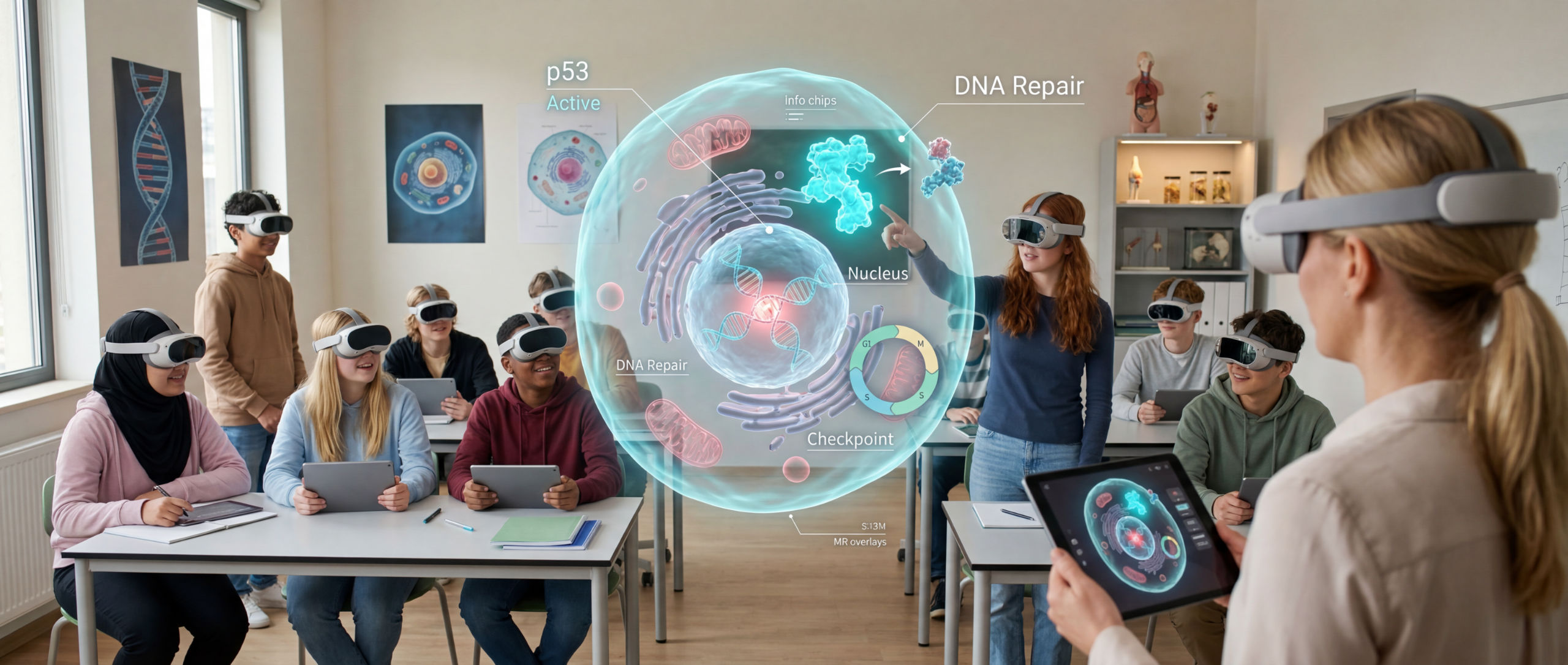
AR becomes everyday
Lighter glasses, more class sets — spatial learning should become as normal as tablets are today. We're already testing with available hardware.
Splexit turns spaces into interactive learning worlds — with augmented reality, open standards, and a community that shares content instead of locking it away.
AR glasses are becoming everyday tools, spatial computing is growing — Splexit is testing the foundations today and helping shape this development with open standards.
Lighter glasses, more class sets — spatial learning should become as normal as tablets are today. We're already testing with available hardware.
Educational content belongs to schools, not tech corporations. Splexit builds on interoperability and transparent technology — that's our founding principle, lived today.
The classroom gets a skin — learning by connections instead of isolated chapters.

Walls turn into oceans, the board into a map — a Columbus lesson becomes the starting point for politics, biology, and evolution. The room reveals connections that usually stay hidden.
Place learning content exactly where it's needed — in the museum, outdoors, or in the classroom. With AR anchoring, reconstructions, 3D models, and stations become tangible, even offline.

Future vision · Concept
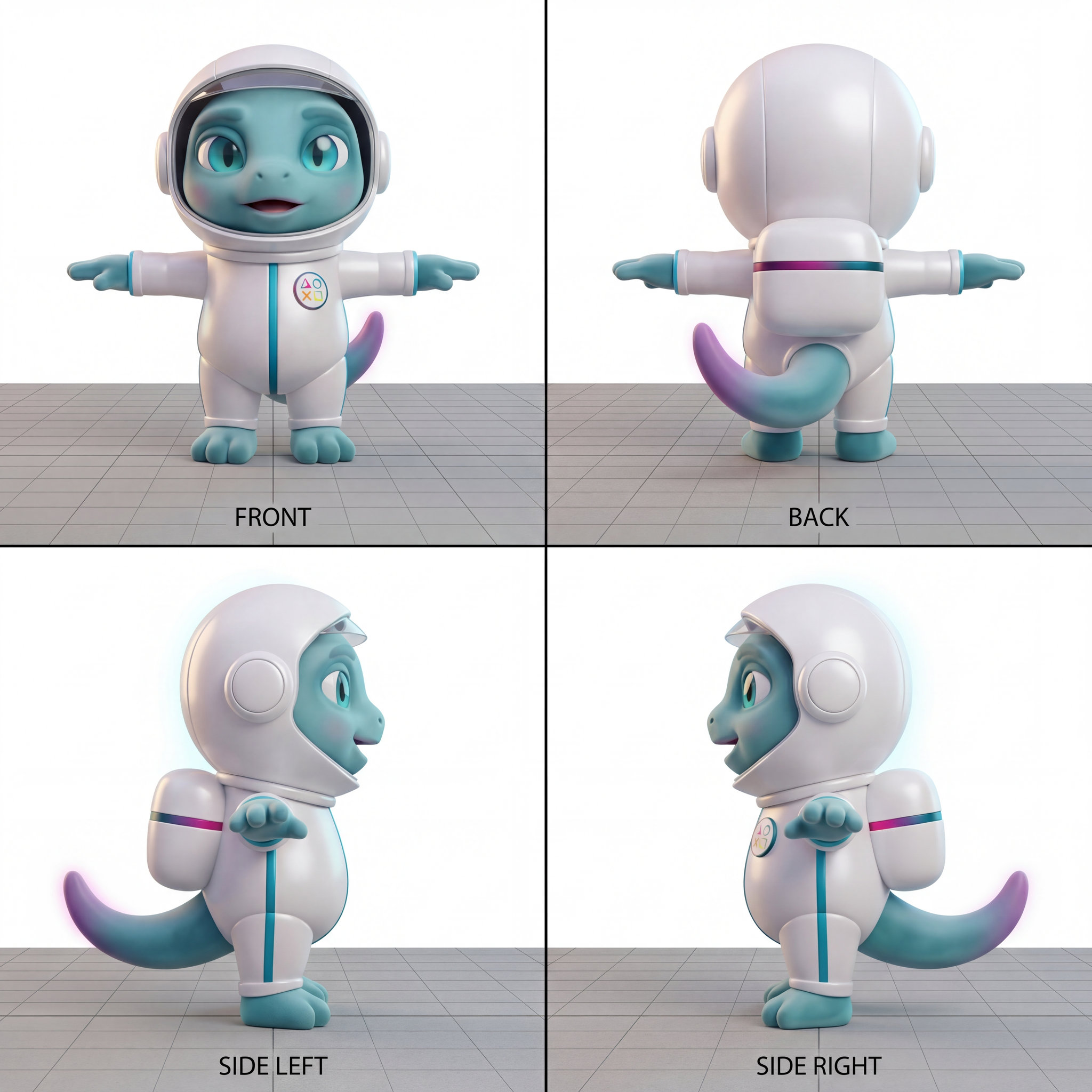
Splexi is our design for an embodied AI co-creator: educators describe their lesson, and Splexi structures it into a spatial learning world — no 3D editor, in dialogue like with a colleague.
A concept and design direction we're exploring — not a finished product and not a fixed roadmap.
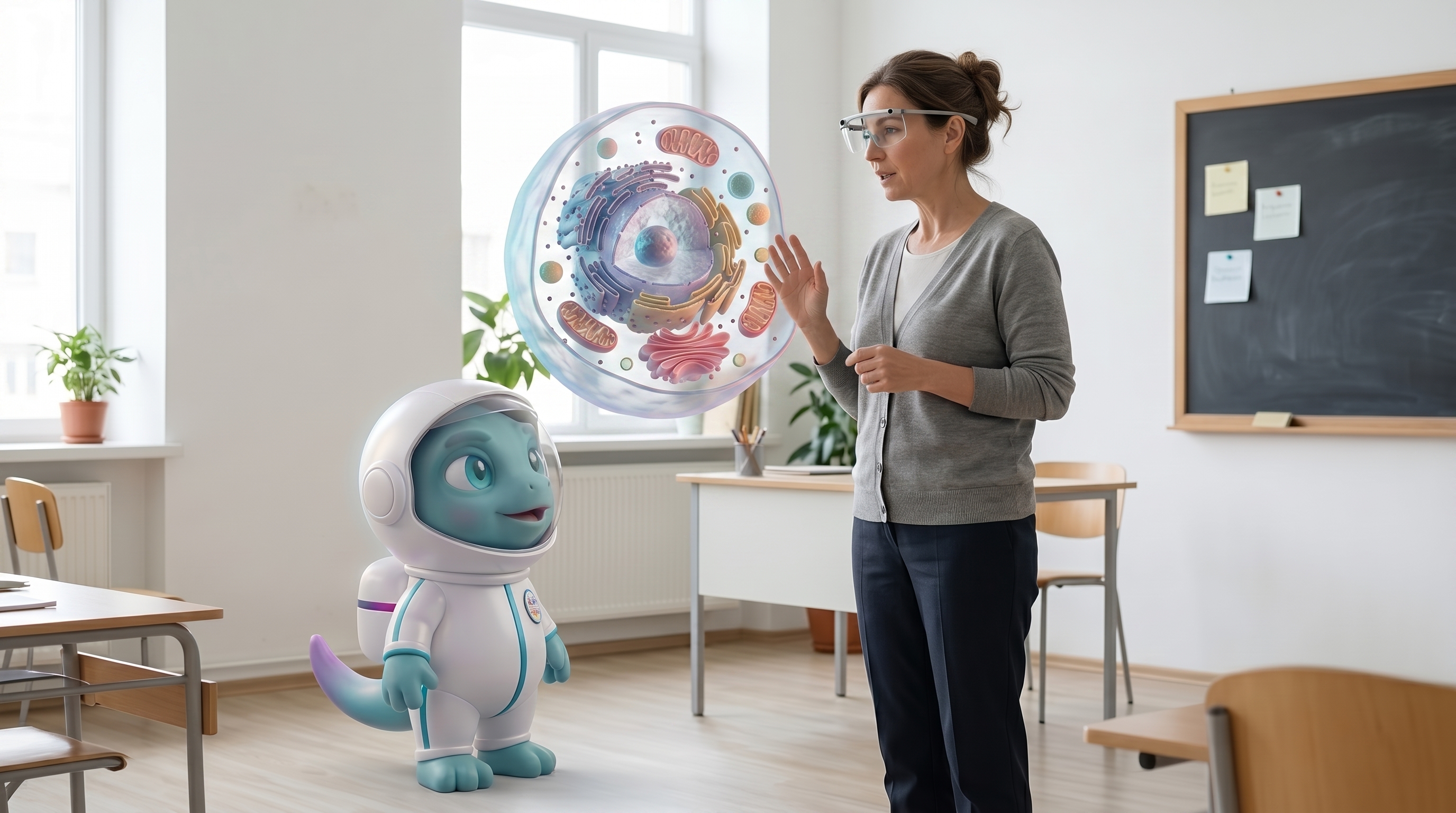
“Describe your lesson. I'll make it spatial.” — Splexi, embodied co-creator
Spatial content today often requires 3D specialists. Splexit provides the infrastructure for XR presentations — Splexi is meant to be the missing creation layer that speaks the language of curriculum planning.
The educator states goals and flow — Splexi confirms, asks follow-up questions, and sets up scenes for the class set. Authors see what learners will see later.
Background: An agent sources assets, structures scenes, and maps them to
learning objectives.
Foreground: Splexi as an avatar in the room — the invisible agent becomes
tangible.
Bring your own AI, text-to-3D pipelines, modular open-source building blocks — schools choose models and tools, Splexi orchestrates the dialogue.
What it could look like — illustration, not a live feature
Cell biology next week — can we start with building a cell?
Sure — I'll fetch a cell model. Labels on the organelles, or clean first?
Labels yes. And then something on mitosis as a second part.
Structured spatial content — ready for the class set. No manual placement.
Splexit is more than an app — a system for spatial, open learning.
Knowledge is anchored in three-dimensional space — from the classroom to the historical site.
Learners and educators create, share, and remix content — like open source.
No black box: open source, GDPR-oriented development, democratic control for educational institutions.
Step by step — together with pilot schools and partners. The first two phases run as part of our IGP feasibility study.
In the funded IGP project (July 2025–June 2026), we tested first XR tours with pilot schools in 90-minute workshops — long-term support instead of one-off events. About the feasibility study
Companion app for presenter workflows; museums, creators, and institutions integrate existing collections as learning modules — three pilot categories from the feasibility study.
A living community with templates and remixes — and exploring Splexi as an AI-assisted creation layer, GDPR-compliant and modular.
Want to partner? On the feasibility study page you'll find the three roles — app ecosystem, museums & creators, educators & schools. Become a pilot partner
Join our pilot phase and help us further develop the first genuine open-source AR solution for everyday school life.
Funded through the IGP programme of the German Federal Ministry for Economic Affairs — free participation for pilot schools


